When installing a web browser on your computer you sometimes have to install new plug-ins which are compatible with your new choice of browser, one of the most popular popular plug-ins to install is Adobe’s Flash.
Most of today’s websites use Adobe Flash, therefore it is no great surprise to hear that Google are apparently toying with the idea of integrating Adobe Flash into their Chrome web browser.
Statistics show that 99% of web surfers already have the Flash plug-in installed, that said I don’t think it will do any harm to Chrome by having Flash integrated. It makes you wonder whether Adobe’s Flash will be an integral part of Google’s Chrome OS when it is released later this year.
As we find out information which confirms/refutes these rumors we will keep you posted, for more details check out the link below.
Everything happens in real time nowadays, even ad management. To wit, Google is adding mobile support for AdWords, giving advertisers and agencies the option of managing their accounts on the go.
Customers won't be able to access the full suite of AdWords functions—forget about starting a new campaign or adding keywords from your phone—but will be able to execute several core AdWords functions, such as changing bid prices, ending campaigns and deleting keywords. Users can customize AdWords alerts available for the parts of their account from which they want constant feedback.
At launch Google is supporting users with iPhone, Android and Palm devices. It won't work with BlackBerry, however. The mobile interface is available to all account holders in English. Google plans to begin rolling it out today.
"It's simply the real-time nature of the channel," said Matt Strain, principal at search shop Trademark Interactive, who has tested the mobile version. "It allows us to see and adjust any fluctuations outside of the norm."
The new interface came after advertisers requested mobile access, according to a Google spokesperson. Google in 2008 created the Adwords Advisory Council, a group of agency and advertiser representatives that gave feedback to Google on changes to the user interface of AdWords. One bit of feedback included, per Google: cut down on horizontal scrolling.
Previously, iPhone 3GS users could access AdWords, although the experience was slow. Users of other phones were out of luck. Google said it would work toward support for BlackBerry devices.
Microsoft does not currently offer a mobile version of its search ad system.
Strain said Microsoft has to catch up in more than just market share, but also in the tools offered advertisers.
"Microsoft, as a software company, needs to embrace, or flat out create, the kinds of tools and technology to empower the search marketer," he said. "If they want to have any stake in this game, they need to focus as much on the process of search marketing as they do indexing results for the engine. If they build great tools, more advertisers will be attracted to what the combined Yahoo/Bing can provide."
Australia's Communications Director, Stephen Conroy, has launched an attack on Google after the powerful search engine company came out last week expressing discontent related to national censorship of the Internet. Google said it will no longer censor its Chinese website and is now keeping a close eye on Australia.
Conroy is behind an attempt to filter websites in that country. A leaked "blacklist" showed several thousand websites intended to be blocked, including online poker businesses that operate legally within Australia. US President Barack Obama has also expressed concern over Conroy's intentions.
From the Sydney Morning Herald:
Senator Conroy has said the blacklist will largely include deplorable content such as child pornography, bestiality material and instructions on crime, but a large and growing group of academics, technology companies and lobby groups say the scope of the filters is too broad and will not make a meaningful impact on internet safety for children.
This opposition argument is supported by the leaked "blacklist". Not only did it contain names of online gambling websites, a Queensland dentist site was also among those appearing on the list.
"Any person or corporation that would be identifiable on the list would potentially be deemed by the general public ... either a child molester or at least in the same category as child molesters," said University of Sydney associate professor Bjorn Landfeldt. "In effect, this could be interpreted by some as a government sanctioned hate list."
The dentist explained why his site may have been identified.
"A Russian company broke into our website a couple of years back and they were putting pornographic listings on there ... [but] we changed across to a different web provider and we haven't had that problem since," Dr. John Golbrani said in a phone interview with the Sydney Morning Herald late last year.
Other Australian sites on the list are canteens.com.au ("Tuckshop and Canteen Management Consultants") and animal carers MaroochyBoardingKennels.com.au.
Google also said implementing mandatory filtering across Australia's millions of internet users could "negatively impact user access speeds", while filtering material from high-volume sites such as Wikipedia, YouTube, Facebook and Twitter "appears not to be technologically possible as it would have such a serious impact on internet access".
"We have a number of other concerns, including that filtering may give a false sense of security to parents, it could damage Australia's international reputation and it can be easily circumvented," Google wrote.
Conroy went on television to take a shot at Google: "Recently the founders of Google have got themselves into a little bit of trouble because notwithstanding their alleged 'do no evil' policy, they recently created something called Buzz, and there was a reaction, and people said well look aren't you publishing private information?," Senator Conroy said.
"[Google CEO Eric] Schmidt said the following: 'If you have something that you don't want anyone to know maybe you shouldn't be doing it in the first place'. This is the founder of Google. He also said recently to Wall Street analysts, 'we love cash', so when people say, shouldn't we just leave it up to the Googles of this world to determine what the filtering policy should be...."
"This is a debate about freedom of access to information for all Australians, an issue of national importance. Let's focus on that," Google said.
"The Rudd Government's controversial internet filter legislation, with add on ‘blacklist' on the side, is still being drafted and is unlikely to be debated in parliament until at the middle of June and might be pushed back even further," states Gambling911.com Correspondent, Greg Tingle. "Internet lovers, gamers, media - journalists, entrepreneurs and lovers or freedom of expression have been rejoicing and see the latest development as a victory of sorts in the internet control ‘war'."
Apple iPad Scratch Resistant Skin is available at Unique Skins for $19.99.
It’s getting very close now. Soon we will all have our beloved iPad in our hands. The one thing you really need to keep in mind is how I can make it my own. Maybe with a cool sleeve or even a nice bag but what if you want something a little more personal. Unique skins have come up with just that.
With their Customizable Scratch Resistant Skins you can use your own photos or art work to customize your Apple iPad. The great part is that it only takes seconds to install. You will get a precision fit to your Apple iPad. You can make your iPad look like anything your imagination can come up with.
The skins come in vibrant colors with a high gloss finish. It is non-permanent and the backing will not leave any residue. The Scratch Resistant Skin for the iPad will never fade, wear, smudge, or smear. Also, it will not void the warranty on your Apple iPad which is very important. Pick the image you want on your iPad and get to ordering so when your iPad gets hear you are ready.
Apple iPad Scratch Resistant Skin is available at Unique Skins for $19.99.
I4U News brings your daily shopping tips of new releases, pre-orders, hot deals and unique gadgets. Read the latest Shopping Tips now.
Much of the coverage of the Apple (AAPL) iPad has been on its lack of support for Adobe (ADBE) Flash. Steve Jobs thinks that Flash sucks. Adobe counters that many sites use Flash, particularly for video, and that Apple is giving their iPad customers an enfeebled web experience. Don’t get taken in by the technical chest-beating. This fight is about money and who will control delivery of video over the Internet — a business that’s likely to become a huge portion of the entertainment industry.
You’ve run across HTML whether you realize it or not, because it is the basic language of web design. HTML 5 is supposed to be the next version of the web language standard. It promises to do everything that Flash does, from delivering video and enabling slick user interfaces to providing a platform to develop small downloadable applications, without the need to download and install a browser plug-in. That should mean fewer complications on end users’ systems and and less need for web site owners to invest in proprietary tools.
However welcome these goals may sound to most of us, life on the web will continue to be complicated for years for a few reasons:
HTML 5 is far from being a stable and established platform. Getting it to a predictable commercial state — which means having the leading browsers support it sufficiently — will take a long time. Until HTML 5 is ready, many web sites can’t and won’t dump Flash.
Flash is so widely established that even if the sites using it wanted to transition to HTML 5, it would take them significant and long efforts.
Leading browsers must support HTML 5 before sites can depend on the technology. Just look at YouTube, which currently delivers video through Flash. Even though parent company Google has set up an experimental HTML 5 interface for “most” YouTube videos, that’s only for people using Apple’s Safari browser, Google’s Chrome, or Microsoft Internet Explore with Chrome framework installed. The vast majority of users still need Flash for their browsers to work, and there is no HTML 5 backward compatibility for older browsers still in use.
Many web sites use Flash to create super behavioral marketing cookies that users can’t easily remove. They make money off the information they gather and won’t want to give it up.
In other words, don’t plan on uninstalling Flash plug-ins or tools for some time to come. But big change is coming, and it will have a big impact on how we experience the web.
SlingPlayer Mobile for iPad would stream higher-resolution video and instantly turn the iPad into a sweet portable TV--particularly if you streamed over Wi-Fi.
Back in February, Sling Media, now owned by Echostar, finally got permission to allow users of its SlingPlayer Mobile for iPhone app to stream video over AT&T's 3G network instead of just WiFi. We've been playing around with the updated app for a little while and are happy to report that it works as well as it does on other cell phones and cell networks. However, as we were watching some March Madness on the iPhone's smallish screen, we couldn't help but wonder what a great a platform the iPad would be for Sling, so we asked John Santoro, Sling's Senior Marketing Manager when the company would release an iPad app. "We're working on an great, new version of SlingPlayer Mobile for iPad that takes full advantage of the iPad's features," Santoro wrote back. "We're really excited about the possibilities. However, since it's in development I can't discuss specific features right now."
Coincidentally, Dave Zatz, the purveyor of zatznotfunny.com and a former Sling evangelist, was also curious about what Sling was planning, and contacted his "old peeps" and got a few more details out of them about expanding the output resolution beyond 320?240.
"When it makes a noticeable difference in quality, we will definitely provide higher resolution streaming," said Dave Eyler, Sling's Mobile Product marketing manager. "The iPad is a good example of a device where we are hard at work on this, but unfortunately it won't be there at the April launch."
In other words, if you own the SlingPlayer Mobile for iPhone app already (it costs a whopping $29.99), you'll be able to use it with the iPad, but you'll have to wait for a true iPad app that expands the resolution. When that day will come, we can't say, but being able to turn your iPad into a high-resolution portable TV would be pretty killer. (In case you've never heard of Sling, it works a little like this: once you attach a Slingbox to your cable or satellite box and tie it into your home Internet connection, you can then tap into the box remotely using a desktop or laptop computer--or various mobile phones running the SlingPlayer app--and stream video in real time. Since being acquired by Echostar, Sling's been working on building Sling functionality into Dish Network's future set-top boxes, but those products have yet to hit the market).
A few suggestion for Sling moving forward:
1. Quickly release a SlingPlayer Mobile for iPad app that streams high-resolution video over WiFi, so people can use their iPads as TVs in their homes. Don't worry about 3G initially--we understand the challenge of streaming high-resolution video over AT&T's 3G network.
2. Stop calling your SlingPlayer mobile app SlingPlayer Mobile. Just call it SlingPlayer for iPhone. SlingPlayer for Android (due out this summer). Or SlingPlayer for iPad. Shorten things up.
3. Stop charging so much for the iPhone app. If 3G streaming is still a sticking point that requires that someone gets paid off (I have no idea what your agreement with carriers is, but I assume some money changes hands), make a free WiFi version of the app. Sonos gives away its iPhone app, and it's really helped that company spark its sales. You might find that a free iPhone/iPad tie-in to your product is good for sales. I'm sure you've thought of this, but, please, just do it.
Anybody else have any other suggestion for Sling?
Apple has released the Golden Master Seed version of iPhone OS 3.2 SDK, allowing mobile applications to be built for the iPad using non-beta tools. Resources between the iPhone OS 3.2 GM Seed, which is accessible to anyone registered with Apple’s iPhone Developer Program, and the previous beta versions seem basically the same at first glance. Apple claims that some 150,000 apps will be available upon the iPad’s April 3 release. Meanwhile, Apple co-founder Steve Wozniak suggested to Newsweek that the iPad would appeal particularly to educational segments and technological neophytes.
Apple issued the Golden Master Seed version of its iPhone OS 3.2 SDK March 29, ahead of the April 3 release of its iPad tablet PC. The release allows anyone registered with company’s iPhone Developer Program to build mobile applications for the iPad with more finalized tools.
Members of the iPhone Developer Program pay for presumably just this sort of access, to the tune of $99 per year.
Resources for the iPhone OS 3.2 GM Seed seem to have remained largely unchanged from beta versions of the platform, including an iPhone Reference Library, Sample Code, iPad Programming Guide and Human Interface Guidelines. Blogs such as Engadget are already parsing the build to see if any radical alterations exist from those previous versions.
Apple claims that some 150,000 apps will be available for the iPad’s launch, with outside analysts suggesting that Apple’s App Store could contain as many as 300,000 apps for the iPad, the iPhone, and the iPod Touch by the end of 2010.
Analytics firm Flurry has reported a 185 percent uptick in the number of new application starts for the iPhone OS over the past few weeks. "We continue to attribute this growth to excitement generated by the impending launch of the iPad," Peter Farago, vice president of marketing for Flurry, wrote in a March 15 posting on the company’s official blog. "A large portion of the applications we are seeing are custom versions of existing applications tailored for the iPad."
The iPad has the potential to become a huge hit, with Morgan Stanley analyst Katy Huberty estimating between 8 million and 10 million units shipped in 2010. In a recent research note, Huberty also noted that the iPad could target the $800-and-under notebook market, a sentiment that if taken at face value could give competitors for that segment a bit of pause.
"Near-term, we believe the iPad will target the sizable sub-$800 consumer notebook market, which equates to 30 million units in the U.S. and 120 million units globally," Huberty wrote. The addition of TV shows, e-books, and other content especially tailored the device could further increase its consumer appeal.
The 16GB version of the iPad sells for $499 with WiFi and $629 with WiFi and 3G. The 32GB version costs $599 with WiFi and $729 with WiFi and 3G, and the 64GB version costs $699 with WiFi and $829 with WiFi and 3G.
Meanwhile, Apple co-founder Steve Wozniak apparently sees the iPad as a device ideal for very specific market segments.
"The iPad could lower the cost of acquiring computers for students. I think it’s going to be huge in the education market," Wozniak told Newsweek’s Daniel Lyons—who also blogs as Fake Steve Jobs—on March 26. "Think about students going off to college. They want an Apple product, but their parents don’t want to spend that much. Now they have the ideal thing. They can go to college and someone may have a whacked-out $6,000 laptop, but the guy with the iPad will get all the attention."
Other target audiences for the device, according to Wozniak, include those who want simple computing—and he plans to buy three: "I’ve ordered one for a friend. Then I ordered two for myself. One with WiFi and one with the 3G."
Given Wozniak’s history with Apple, the much-publicized "two iPads per customer" rule will hopefully be waived.
Morning and midday anchor Art Barron is being kicked off KSTP-TV but not out of the building.
"He will do midday up until the May book starts and then he will transition fully into a Web position," KSTP-TV news director Lindsay Radford told me today. "He will be a Web producer for us. We are launching a whole bunch of community sites and have hired a whole bunch of people for that. God bless Art. He's got the best attitude in the world."
As a producer, Barron's face won't be seen anymore, which means that he'll probably experience a cut in pay, broadcast insiders tell me.
"It depends on a lot of variables," Barron begged to differ. "Obviously, it's not going to be anchor pay. But the Hubbards take good care of me. I enjoy working for them. You go into this knowing these things happen -- for whatever reason, changes are made. State of the biz."
With Barron out of a news anchor chair, the KSTP morning show anchor desk again will have the more traditional two anchors, Vineeta Sawkar and Rebekah Wood. Wood became the third when she was removed from the afternoon variety show.
Broadcast insiders suspect that something happened that has not been revealed yet. Barron said not so. My original tip was that Barron had been fired, so this is better news. A divorced father who's been raising his three children alone for the past 10 years, Barron recently became engaged and is haggling with his wife-to-be over wedding dates.
"This [new assignment] gives me an opportunity to do some other things and prove myself in this capacity," said Barron. "We have all these neighborhoods, and what I am doing is finding stories that concern people and I post them on the Web and we create a page for each one of these neighborhoods."
C.J. is at 612.332.TIPS or cj@startribune.com. E-mailers, please state a subject -- "Hello" doesn't count. Attachments are not opened, so don't even try. More of her attitude can be seen on FOX 9 Thursday mornings.
A sculpture that may be a lost work by British artist Eric Gill was withdrawn from sale in Cheshire last week.
Britain’s provincial auctioneers are frequently the source of intriguing stories about goods that surface unrecognised or with a provenance shrouded in mystery. Titian’s Laughing Man, bought at a Gloucestershire saleroom in 2007 for £2.6 million when estimated at just £3,000 (and now worth £20 million), is a good example of the former.
The latest story, only beginning to unfold, concerns a sculpture of a naked woman that was withdrawn from a sale in Cheshire last week. Estimated to fetch £300, it may turn out to be a valuable work by the British artist Eric Gill that has been missing from the collection of the Manchester Art Gallery for several decades.
The carved stone bust was due to be sold in a mixed art and antiques sale at Adam Partridge Auctioneers near Macclesfield last Thursday. According to Partridge, it had been consigned for sale by a local man in his late seventies who had been a stonemason at J & H Patterson in Manchester. He had been given the sculpture in the Fifties to restore, he told Partridge, but it was never collected.
Adam Partridge is known through his appearances on television valuation programmes such as Flog It!, Bargain Hunt and Cash in the Attic. Last year his company was voted runner-up to Christie’s as internet auctioneer of the year. But his saleroom does not often make headline news. The house record is a mere £27,000 achieved last September for a Chinese libation cup.
Had the withdrawn sculpture been sold last week, it would almost certainly have made more than that. After he advertised the work in the trade press, tentatively attributed on stylistic grounds to Eric Gill, Partridge was inundated with calls from interested art dealers. Sculptures by Gill are rare and have fetched as much as £145,000 at auction. But one dealer informed him that there may be a problem. He pointed out that an identical-looking sculpture is illustrated in a book on Gill by the art historian and former Tate curator Judith Collins, where it is described as belonging to the Manchester Art Gallery and “lost by 1992”. The date means only that the work was missing then, and does not preclude that it may have been lost earlier. Partridge, who had not seen Collins’s book, contacted the Manchester Art Gallery, and withdrew the work, pending further investigation. “I was uneasy about the legal title to the work,” he said.
As yet, Manchester has not confirmed that the withdrawn piece and its missing sculpture are the same. When contacted by The Daily Telegraph last week, a museum spokesman said: “We can confirm that an Eric Gill sculpture of a similar description was acquired by Manchester Art Gallery in 1925 and was recorded as missing in 1970.” But until they had seen the work that was to have been auctioned, they were reluctant to comment further.
Collins notes that the artist appears to have had an on-off relationship with the work because, he wrote in his diary, he “smashed her in half, but mended her”. She titles the missing work as Torso-Woman, and dates it to March 1913. She notes that it was bought by the collector Charles Rutherston in 1914 for 10 guineas, and then given to the Manchester Art Gallery in 1927.
The story so far leaves much to be explained. Assuming the withdrawn work to be the same as the lost sculpture, what were the circumstances in which it went missing? Are there any gallery records? And then, who does have legal title to it?
Partridge says his client has been advised that he has looked after it for so long that it is now his. “I’ve told him I would now estimate it at £30,000 to £50,000. He wants to sell it. He has no intention of passing it back.”
Congratulations to Go Figurative website's first art show in London, which proved a rip roaring success.
Featuring such works as Nicholas Phillips' Seven O'clock News, above, it was bound to do well.
Alongside Phillips' Gerhard Richter-like watercolours the show displayed an enormous depth of figurative painting and sculpture.
There next exhibition is of up-and-coming Belfast artist, David McDowell which opens on Thursday and runs until May 5 at the Grand Opera House, Great Victoria Street, Belfast.
Rights and freedoms have been the topic du jour of late.
First, we had the controversial cancellation of a speech that American right-wing pundit Ann Coulter was to give at the University of Ottawa. Even detractors of Coulter admitted this was a defeat of the right to free speech.
I have to agree. Universities are supposed to be places where all forms of ideas can collide. They are to intellectual debate what the UFC octagon is to physical confrontation. Settle your fight in the ring because brawling in the parking lot proves nothing.
I'm noticing a worrisome trend in Canada, wherein student protesters are more interested in displaying self-righteous rage than debating errant ideas.
I recently watched a talk online given by conservative commentator Michael Coren at Queen's University. The topic was abortion.
Certainly you'd expect it would be contentious. But the campus had to have security officers inside the lecture hall as several pro-choice students marched in with signs looking to disrupt his talk.
Coren, no pacifist when it comes to debating, asked only that he be allowed to give his speech uninterrupted and then he would gladly take their questions.
The students barely afforded him this courtesy as they repeatedly giggled and interjected at points.
When they did get a chance to ask questions, they used the opportunity to grandstand rather than enter a dialogue with any insights.
Coren later referred to them as "rebels without a clue." It was a perfect description, as they did not come to that lecture for honest debate. They came looking to disrupt someone from professing a different worldview than their own.
It's an interesting strategy for students to take: rather than risk losing the debate, they refused to participate in it. They tapped out before the fight even began.
As for Coulter, after viewing more of her interviews, I have come to this conclusion: she is a performance artist in the tradition of Sacha Baron Cohen (Borat) or the late Andy Kaufman.
In every interview, she deliberately looks for a point where she can say something outrageous and inflammatory – yet does so with a very convincing air of sincerity.
It's brilliant acting (or complete psychosis). I'm convinced she is actually curious to see how far she can push the envelope – to see if there is a line she cannot cross. So far, the line keeps moving for her.
Truth be told, she shouldn't have been invited to Canada by the U of O, she should have been invited by Yuk Yuk's. The sooner we all stop taking her act seriously (especially conservatives), the better.
The other freedom on trial last week was that of Quebec Muslim women to wear the full-face veil, the niqab. The Charest government has ruled that if a person wants to access government services, one must present their full face for view.
That's really asking for the moon, isn't it, to be able to properly identify someone before handing over a health card or driver's license?
Apart from that practical application there is the issue of the niqab being a display of gender inequality, something the secular state does not allow.
The conservative Muslim lobby counters that the Quebec ruling is an infringement of their religious rights. But as other Muslims have pointed out, the niqab is not required by Islamic law; it is strictly a custom, specific to culture.
Here's my suggestion to help the niqab-wearing women win back their rights. Ask your husbands to wear it too. That way it is no longer a gender equality issue.
Surely the lads would be willing to sacrifice their faces for the good of the cause? We could at least put it up for debate – just not at the University of Ottawa.
BEIJING/SHANGHAI – China's state-run Xinhua news agency launched a new broadside against Google Inc on Monday, saying in an angry commentary that the company had reneged on promises to abide by Chinese law.
Speculation is swirling that Google will soon announce a decision to pull out of China, or at least shut down its Chinese search engine.
The Financial Times, citing a person familiar with the situation, said the company could say on Monday that it will close its Chinese search engine.
Google has not formally unveiled any such plans.
Two months since Google said it would no longer agree to abide by Beijing's censorship rules even if that meant shutting its Google.cn site, some Chinese Internet users and state media are baying for the company to pull out.
Xinhua, in a signed commentary, said Google had promised when it entered the Chinese market to filter its search engine for "harmful content," in accordance with the law.
"Now Google suddenly wants to break its promise, and if it's not satisfied it will criticize China for a worsening of the investment environment," Xinhua said.
"This is entirely unreasonable. What has changed is not China's investment environment. It is Google itself."
The burst of angry Chinese comments suggested that, in spite of the widespread popularity of Google amongst educated Chinese, the government is steering state-run media and websites to lump the company together with other recent disputes with Washington that have stirred nationalist rancor in China.
"Get the hell out," wrote one user on the website of the nationalist tabloid the Global Times (www.huanqiu.com), in remarks echoed by other readers.
"Ha ha, I'm going to buy firecrackers to celebrate!" wrote another, in anticipation of the company confirming its departure from the online search market.
CULTURAL IMPERIALISM
Joseph Cheng, a City University of Hong Kong politics professor, said China's ruling Communist Party was deploying nationalism to stifle debate about censorship.
"The criticism of cultural exports, or cultural imperialism, is a kind of defense to justify the Chinese authorities' censorship controls," said Cheng.
"In dealing with the American government, the Chinese authorities will try to emphasize that this is only a commercial dispute and has nothing to do with Sino-American relations."
A Global Times editorial cited online surveys as showing 80 percent of respondents said they could not care less if Google withdrew from China, the world's largest Internet market with an estimated 384 million users.
Though Google has remained mum on the progress of talks, the firm's chief executive said earlier this month that an outcome is expected "soon."
The Google case has spread beyond censorship and hacking and has become a diplomatic knot in Sino-U.S. relations, already being challenged by spats over Taiwan, Tibet and the value of the Chinese currency.
The United States is studying whether it can legally challenge Chinese Internet restrictions, a top U.S. trade official said recently.
BLOW TO INNOVATION?
Analysts said if Google withdrew from China, the biggest losers would be its millions of Internet users.
With two research and development centres in China, hundreds of sales staff and engineers working on the Google Android platform and other initiatives, analysts said all may come to a halt if Google decides on a pull out.
"This is not a good thing for Chinese netizens because Google has been the leader in innovation in the search engine field," said Cao Junbo, chief analyst with iResearch, a Beijing-based research firm specializing in technology matters.
Currently, Google offers Google Maps, Gmail and free music downloads to Chinese users, all of which could be in jeopardy if the company leaves.
Even Google's mobile platform Android is not safe, as Google products such as search which are embedded into the platform will stop working if Google withdraws, making the platform less desirable to consumers, analysts said.
Google's withdrawal will open up China's $1 billion search market to more local firms, Cao said.
The biggest beneficiary will be domestic search leader Baidu Inc, which already has a sophisticated search advertising display system and a robust sales and customer support team.
Others such as Tencent Holdings, China's most valuable Internet company, may also benefit as the firm runs the country's largest instant messaging platform that it could tap into to expand its search network.
The Hackathon is over and the only browser left standing is Google Chrome. This is the second consecutive year that Google has managed to leave the competition unscathed. In fact, according to TheNextWeb, this time around no one even attempted to hack Chrome.
Google obviously went into the competition well prepared. It fixed as many as 11 flaws just ahead of the competition. However, so did Apple, which recently pushed through 16 patches for Safari. Safari’s fall also proves that there is more to Google’s success than its lowly market share.
In fact, given that Google Chrome had managed to survive last year’s Pwn2Own, most people expected hackers to be gunning for it this time around. Google credits its “sandboxing” technique , which forces processes to run in a restricted environment, for Chrome’s success. While, sandboxing might be the key behind Chrome’s outstanding security track record, it definitely isn’t the sole contributor. Even Internet Explorer 8 utilizes sandboxing (Protected Mode), yet it fell quite easily.
Google built Chrome from the ground up with focus on security and speed and their efforts are certainly paying off. It is the only major browser, which is yet to be surmounted in the Pwn2Own contest. That alone is a laudable feat.
Cities Desire Google Fiber High Speed Broadband Internet Access. There are hundreds- if not over a thousand – communities seeking to be the site of a test of a Google high speed broadband network. Google has announced that their proposed internet options would include speeds of 100 times faster than the current home-based broadband internet service.
Google’s broadband would be powered by a fiber optic network, and is state of the art. Cities such as Grand Rapids, Michigan Topeka, Kansas Fresno, CA, and Portland OR are rumored to be at the top of Google’s list.
These communities are anxiously awaiting the announcement from the company as to which city or cities will be awarded the testing honors.
If successful during the test stages, Google broadband could revolutionize web browsing as we know it. The ultra high speeds provided by their proposed broadband access could allow for a lot of great benefits, such as faster downloads.
Supposedly, Google wants to bring their test site to approximately 500,o00 people. There’s not any indication of where Google is leaning to place their test site or sites, but once they announce which city or cities are lucky enough to have that honor we will let you know.
Kolkata: Google to launch Nexus One in India! According to the reports, Google is soon going launch its Android-powered smartphone Nexus One in the Indian market. However, there may be a slight cut down it its features.
As the reports say, Google is working to introduce a new version Nexus One for India and Russia, deducting some of the features of the main version of the phone which is being sold in the international market.
To make the phone available to the reach of people in these countries the internet major has slimmed down its features resulting a cut down in the price.
It is to be mentioned here that Google launched its new smartphone Nexus One internationally in January 2010 which aims to challenge the likes of Apple, Blackberry and Nokia.
IDG News Service - The battle between China and Google dominated the headlines this week after Google decided to stop censoring its search results. China also caused some grief with a U.S. Internet domain registrar after it demanded detailed information on the people who registered Web sites in China. Hackers looking to make a lucrative living by selling pilfered credit card information may want to rethink their career options, as the person responsible for committing what is believed to be the largest data breach ever was sentenced to three 20-year prison terms this week. Finally, the CTIA Wireless show brought more news about future phones and how femtocells may finally be ready for use in people's homes.
1. Google stops censoring in China and China defends censorship, plays down Google harm on US ties: Google defied China's government on Monday and fulfilled its pledge to stop censoring search results from its Chinese search engine. Users who visited Google.cn were directed to Google's Hong Kong search engine, which delivers information on topics that the Chinese government deems politically controversial and bans search engines from displaying. The row began in January when Google claimed Chinese hackers attacked its servers and it threatened to exit the country or offer unrestricted Web searches. The Chinese government criticized Google's decision but has yet to block access to Google.cn.
2. Gonzalez sentenced for multimillion-dollar credit card scam and Hacker Gonzalez gets 20 years for Heartland breach: The hacker who orchestrated one of the largest cybercrime identity heists ever -- if not the largest -- was sentenced to three 20-year prison terms on Thursday and Friday. Albert Gonzalez, 28, played the lead role in organizing hacks that netted credit card numbers from major U.S. retailers including TJX, Office Max and DSW. Prosecutors said Gonzalez and his co-conspirators acquired millions of credit and debit card numbers, but attorneys for the prosecution and defense agreed that attaching a dollar amount and victim count to the crimes may prove impossible. However, the companies that were affected by the hack claimed the crime cost millions of dollars, with TJX putting the figure at $171.5 million.
3. GoDaddy to stop registering .cn domain names: Google isn't the only U.S. company taking on China's Internet policies. Domain name registrar GoDaddy.com will stop registering .cn domains in China after the country's government demanded information on previously registered domain names. The Chinese government wanted GoDaddy to provide it with photo identification, business identification and a signed registration for owners of all .cn domains that the company has registered during its six years in China. Concerns about the safety of the individuals registering the domains and the threat this posed to an open Internet prompted GoDaddy's decision, a company executive said. The Chinese government claimed that the domains would not work if the domain registrar failed to fulfill its information request.
4. China's Great Firewall spreads overseas: We promise this is the last reference to China and security this week. A networking glitch caused some computers in the U.S. and Chile to be redirected to bogus addresses when they tried to visit Facebook, Twitter and YouTube. It appears that at least one Internet service provider began fetching DNS (domain name server) information from a server in China, effectively spreading China's Internet censorship -- the so-called Great Firewall of China -- overseas. Security experts were still uncertain what caused this problem.
5. Nokia hopes Symbian phones will help it win US market, Femtocell technology expanding beyond the box, Verizon Skype application available Thursday and AT&T will go national with its femtocell: Anyone with an interest in wireless communication turned their attention to the CTIA convention in Las Vegas this week. Nokia used the event to discuss how it will use Symbian smartphones to capture a greater share of the U.S. smartphone market. Verizon Wireless announced at the show that starting this week, some of its customers can download the Skype Mobile application. AT&T also announced plans for a national rollout of its version of a femtocell, a tiny base station that can boost broadband coverage in homes and other locations.
6. EC launches new drive for EU/US bank data-sharing agreement: The European Commission and the U.S. government have returned to negotiations on the sharing of European banking information with the U.S. for security reasons. Europe's data security rule prohibits the information from being passed to the U.S., but authorities in the U.S. claim the data is useful in fighting terrorism. The initial agreement was voted down by the Commission over concerns that it didn't adequately address citizens' privacy rights. The U.S. demanded the bank data after the Sept. 11 terrorist attacks, but it approached a major bank networking firm for the information instead of going through the European Union.
7. Providers question parts of FCC's broadband plan and Republicans question parts of FCC's broadband plan: Republicans and broadband providers, also known as the champions of deregulation, questioned parts of the national broadband plan that the U.S. government introduced last week. The providers feared that the plan would lead to increased regulation and rulemaking processes, since the measure nearly classifies providers as common carriers, a designation that subjects them to many U.S. Federal Communications Commission regulations. Republicans presented the same arguments as the carriers, with one congressman questioning the need for the program because, he said, 95 percent of U.S. homes have broadband.
8. IBM, Microsoft court SMBs with cloud, appliances: IBM and Microsoft are taking their wares to the small and medium-sized business (SMB) market, a space that large IT vendors have yet to serve, according to analysts. A Microsoft executive said the SMB space is underserved, and Microsoft sees the company's cloud computing offerings as a good fit for companies looking for affordable IT options. IBM looks to offer SMBs on-site software options, citing bandwidth concerns as a factor that may limit SMB adoption of cloud computing. While vendors may disagree on what type of IT best serves the SMB space, one analyst said the debate is positive because IBM and Microsoft realize that one model doesn't fit every business.
9. Proposed US law would single out cybercrime havens: A proposed cybersecurity bill in the U.S. Senate may prove that bipartisanship in the U.S. Congress is possible. The legislation, co-sponsored by New York Democrat Senator Kirsten Gillibrand and Utah Republican Orrin Hatch, would force the White House to identify international cybercrime hotspots and develop plans to address the issue. The bill looks to crack down on international cybercrime, which is on the rise and proves difficult to resolve across foreign borders. The legislation would provide the president with a yearly assessment of international cybercrime and would permit suspensions in aid or financing to countries that do not act on curbing online crime.
10. New version of secret copyright treaty text leaked: A clause in a leaked document that is supposedly the Anti-Counterfeiting Trade Agreement caused concern among civil rights groups and Internet users. The clause supposedly calls for countries that sign the agreement to implement a "three strikes" law that cuts off Internet access for users who violate copyright laws three times. One part of the clause says ISPs will not be held liable for any copyright material that their networks carry. However, additional wording says this measure is only valid if ISPs terminate the accounts of repeat
Love Sex Aur Dhoka is an upcoming Hindi movie by director Dibakar Banerjee with debut actor Anshuman Jha, Shruti, Raj Kumar Yadav, Neha Chauhan, Amit Sial, Arya, Herry Tangdi in the cast. Read the film preview at CalcuttaTube.
A digital film with a hidden camera playing a character by itself, ‘Love, Sex Aur Dhokha’ features a bunch of newcomers with no mainstream trappings to it, but sex and voyeurism constitute a major driving force of the narrative. The movie releases Friday.
After having earned critical acclaim for ‘Khosla Ka Ghosla’ and ‘Oye Lucky! Lucky Oye!’, director Dibakar Banerjee maps a new terrain with his bold film ‘Love, Sex Aur Dhokha’ (LSD), which highlights voyeurism in society.
‘Voyeurism is what the whole society finds itself trapped in and this is the reality that I wish to bring through my film,’ Banerjee had told IANS.
A co-production of Ekta Kapoor, Shobha Kapoor and Priya Sreedharan, it is a small-budget movie that will release across 350 screens in India. Unlike other Bollywood films, it won’t have an international release.
‘We are not releasing ‘Love Sex Aur Dhokha’ internationally because the recovery for small movies is not possible outside. We plan to take it to festivals instead,’ Sunny Khanna, senior vice president of Balaji Motion Pictures, told IANS.
‘Love, Sex Aur Dhokha’ takes a look into three stories unfolding across and weaving through each other.
The first story goes like this – in a second rate film institute in north India, a final year student gears up for his diploma film. In pristine tackiness, with an amateur small town cast, Rahul starts etching out the themes of star-studded Bollywood love in his magnum opus and then falls in love with his heroine.
Somewhere in the same city, Adarsh, a tech savvy security camera agency executive installs four security cameras in a 24-hour departmental store with the idea of making a porn clip.
He starts to woo Rashmi, a simple salesgirl, when suddenly a shootout happens in the store and she saves a life. For the first time, Adarsh notices a woman in her.
In another corner of the city, Prabhat, a sting journalist teeters on the brink of total meltdown. Going through a divorce and about to be fired from his job, he attempts a series of failed suicides. And then he meets Naina, who is also trying to commit suicide.
Naina had been promised a music video by a reigning Bhangra Hip Hop star who slept with her in exchange for the offer, but the video finally went to a Russian blonde.
Prabhat and Naina come closer over a series of attempts to seduce, blackmail and threaten the hip hop star. They plan the final sting to catch the star on tape admitting his follies.
Despite its bold subject, Banerjee is not worried about the reaction of audiences and critics.
‘If you don’t like the title and think that it may not have the content that would be appropriate for you, then don’t watch ‘Love, Sex Aur Dhokha’. I know there is an audience waiting for the film and it is that segment which wants to call a spade a spade. In any case, the film isn’t designed for those who wish to escape from the realities of life,’ he said.
The music track of the album has also sparked controversy for its crude lyrics.
FASHIONABLE MAN: Visesio Louis Thomsen is exhibiting a collection of his award-winning dresses.
One of Manukau's most celebrated fashion designers is holding his first exhibition.
Visesio Louis Thomsen says the exhibition's a collection of his "favourite pieces" and winning garments from various fashion shows.
Last year he won the eveningwear section at Westfield Style Pasifika and the Manukau Designer Award at Villa Maria Cult-Couture.
In 2008 he won the Villa Maria Cult-Couture Premier Award and the Matrimonial Bliss category.
In fact he has won an award at every Villa Maria Cult-Couture event since he graduated with his AUT University design degree in 2003.
Mr Thomsen designs, cuts and sews each garment, mixing traditional and modern processes and materials, including tapa, fine mat, silks and satins.
"I'm inspired by Samoan culture and the colourful flowers of the South Pacific and the white sandy beaches," he says.
Ideas for his creations come to him all the time, he says.
"Sometimes I have a dream about a garment – I wake up and I start sketching."
His love affair with fashion started when he was younger and watched and helped his mother sew.
He chose it as a career because "I love designing clothes and making people beautiful".
Working out of the garage in his Manurewa home, Mr Thomsen specialises in making dresses, particularly for weddings.
He has a long list of clients especially from the Samoan community.
Mangere Community Arts Outreach Service asked him if he could exhibit there because they liked his work.
Although he's nervous about the exhibition, Mr Thomsen says he's looking forward to "showing my talents to the community".
"Most people have heard about me but don't know what I'm doing."
Visesio Louis Thomsen's exhibition is on at the Mangere Community Arts Outreach Service in the Mangere town centre until April 3.
With about 90 works including vintage prints, pastels, maps, and paintings, its easy to get lost in Europe art.
Dallas Museum of Art Gustave Courbet, “The Sea-Arch at Étretat” 1869
DALLAS — I got a chance to visit the Lens of Impressionism exhibit at the Dallas Museum of Art this weekend and loved it. The exhibit explores impressionist painting’s response to early photography in the mid to late 1800s on the coast of Normandy. With about 90 works including vintage prints, pastels, maps, and paintings, it’s easy to get lost in the European art. Here are some of my personal favorite artists and pieces from the exhibit: Eugène Boudin, “Bathing Time at Deauville” 1865 -- This oil painting is an example of the time in which it was painted. Women on the beach in full clothes and men wearing suits is much different from what you would find on any coast today. Boudin was one of the few artists who insisted on painting in the open air and painted directly from nature. He taught Claude Monet the importance of painting outside and Monet said that when Boudin painted this scene, suddenly a veil was torn from his eyes and his destiny as a painter opened up. Gustave Courbet, “The Sea-Arch at Étretat” 1869 -- With this beautiful painting of the limestone cliffs off the coast of Normandy, the Étretat seems to be a peaceful destination. The texture of the painting gives you a sense of the eroded sea arch in the distance, as well as the rugged shore. This beach was a popular tourist attraction in the 1800s. Claude Monet, “The Sea at the Havre” 1868 -- Pure white and mixed blues control this painting by Monet that illustrates the smooth turning of water. After experimenting with working outdoors, Monet learned that there was importance in the first immediate impression of a subject. Gustave Le Gray, “The Brig Upon the Water” 1856 -- Photography was still in its early stages when Le Gray snapped this overexposed photo of the sea. For the first time, a photographer had captured the sky and the sea together over a negative print. It became a sensation and journalists of the time raved over the style that arrested movement and captured light. The natural blurring was properly balanced to evoke a particular mood. This photo left a lasting effect on impression painting. Henri Le Secq, “Dieppe, Fishing Boats at Low Tide” 1854 -- The photo, along with its original paper negative, stands out among the others. The contrast between the negative and the modern salted print is amazing.
The exhibit also has an interactive audio tour to learn more about the art on display. And now for first time, you can use any smartphone to listen in on the smARTphone tour of the exhibit. The Lens of Impressionism continues until March 23. Click here to get tickets.
LAS VEGAS -- Microsoft on Monday showed off the first range of third-party apps for Windows Phone 7 and demonstrated how easy it is to write applications for its new phone platform, including writing two apps in 10 minutes each.
A range of big-name developers will be on board for the first apps, including game developers Electronic Arts and Glu Mobile, social networkers Seesmic and Foursquare, the AP, Pandora, Sling Media, and SPB Software.
The user interfaces of Windows Phone 7 apps tend to be similar, with a lot of big text to tap on, white writing on black backgrounds, and a touch "icon bar" along the bottom with small icons enclosed in circles.
Apps plug into various places on the new Windows Phone 7 platform. Photo editing apps can be accessed right from the photo viewer. Games connect to Xbox Live. Video apps such as Netflix are accessible right from the Music (aka Zune) menu. During a presentation at the MIX conference here, Microsoft demonstrated many of these new apps. To check out the full array, see our in-depth photo gallery above.
Most third-party apps will be written with Microsoft's Silverlight platform, it seems.
Windows Phone 7's developer tools, including Microsoft Visual Studio 2010 Express, a Windows Phone 7 Series plug-in for Visual Studio 2010 RC, Microsoft Expression Blend 4.0 Preview, XNA Game Studio 4.0, and a Windows Phone 7 emulator, will be available for free today to everyone at live.visitmix.com.
BJ Penn, the UFC lightweight champion. Sammy Dallal / The National
It has been more than a decade since BJ Penn, the Ultimate Fighting Championship (UFC) lightweight champion, made his professional debut and in that time he has built up a reputation as fearsome as any in mixed martial arts.
The American, who will defend his lightweight title for the fourth time at Yas Island in Abu Dhabi next month at UFC 112: Invincible against Frankie “The Answer” Edgar, is only the second fighter after Randy Couture to hold UFC titles in two weight categories.
And having already successfully defended his title three times against formidable opponents Sean Sherk, Kenny Florian and Diego Sanchez, Edgar, 28, is likely to have a tough task ahead of him.
“I always have fighting inside my head and heart,” Penn says. “It is not constantly in my head that I am a champion or a UFC fighter. I forget about that. It is very important to other people, and I am glad to have the support, but fighting is my passion. It is what I like to do.”
Born to a father with English and Irish heritage, and a third generation Korean-American mother in December 1978 in Hilo, Hawaii, Penn is the youngest of four children, three of whom are called Jay Dee, while the fourth is named Reagan. It is his status as the youngest that resulted in the nickname “Baby Jay” or BJ.
Despite being the youngest of four boys he was, he insists, never much of a fighter.
“I guess growing up, it was pretty much a normal life, as I got older I used to get into some fights but nothing unusual,” he says. “My dad took us to a couple of karate classes when we were young but we didn’t really get into it. My dad had been a black belt in judo but I never really cared about martial arts.”
As Penn got older, however, he started experimenting with boxing.
“There were a bunch of kids in the neighbourhood who used to come over and we would spar. We had a couple of pairs of boxing gloves, it just used to be friends on friends,” says Penn, 31.
When he was 17, fresh out of high school and with no clear career path ahead of him, Tom Callos, a sixth-degree taekwondo black belt, moved into the neighbourhood. On his first day in Hilo he placed leaflets around the area looking for judo and wrestling partners. Penn’s father, also named Jay Dee, spotted one and called to say that his boys would be interested.
Sean Sherk is knocked down by BJ Penn in the third round of their UFC lightweight championship fight at the MGM Grand Garden Arena in Las Vegas in May 2008. Penn went on to win. Eric Jamison / AP
“Us kids would hang around the neighbourhood and he wanted some people to wrestle with,” Penn recalls. “Finally we went down. He checked me out and that’s when the bug started and I got addicted to jiu-jitsu.”
Callos, who had started learning jiu-jitsu 18 months earlier, began teaching what he knew to BJ, his brother Reagan, and their friends, a couple of times a week at the Waiakea Recreation Centre. A few months later Penn accompanied Callos to San Jose, California, “because he had some business to do” and was introduced to Ralph Gracie, Callos’s former instructor.
“He [Gracie] saw that I could get somewhere and told Tom that,” he says. “When I came home my father said, ‘If you are not going to school, or working, in a couple of months, you are going to San Jose’, and that time went by with me hanging around the house drinking beer.
“My dad sent me out and said I should get my life together and go and do jiu-jitsu.”
Penn moved near to Gracie’s gym in San Jose and two years later earned his black belt in Brazilian Jiu-Jitsu (BJJ), a process that usually takes at least five years. He went on to win the 2000 World Jiu-Jitsu Championship.
“I thought it was cool but it was never going to be my life,” he adds. “I wasn’t born to be a UFC champion or a jiu-jitsu champion. If Tom had never moved to my neighbourhood it is hard to guess what I’d be doing.”
Penn met Dana White and Lorenzo Fertitta, owners of the UFC, while they were BJJ students long before they took over the ailing brand.
This meeting would later lead to Penn’s entrance into the Octagon on May 24, 2001, as a lightweight at UFC 31, where he would finish Joey Gilbert four minutes into the first round with a technical knockout (TKO).
“They ended up buying UFC and I asked them to get me in,” Penn says. “They pulled some strings, I was just going to try it one time, but the rest has become history.”
Penn went on to knock out the lightweights Din Thomas and Caol Uno before losing a championship bout to the then lightweight champion Jens Pulver.
When Pulver later relinquished his title Penn fought Uno again for the vacant belt at UFC 41, a fight that ended in a draw and saw the lightweight division suspended.
In 2004 Penn moved up a weight division to beat Matt Hughes, the five-time defending UFC welterweight champion, who will also be on the card at Ferrari World on April 10.
Penn left the UFC but returned in March 2006 as a welterweight, losing to Georges St Pierre, the current UFC welterweight champion, by a split decision.
On January 19, 2008, Penn fought and beat the lightweight contender Joe Stevenson at UFC 80 to become the lightweight champion – a title he is still successfully defending.
“I didn’t know it would take me this far,” he says. “It keeps me in shape, I enjoy the training and I like the fact that there are so many moves to master, and they all go together a bit like a puzzle.”
Despite the UFC grossing more annual pay-per-view revenue than almost any other promotion, its fighters gracing the covers of umpteen magazines and live events selling out, Penn has shunned the celebrity lifestyle to stay in his hometown of Hilo surrounded by his friends and family.
“I don’t know if it is important to me to live in Hilo, it is just very natural to me,” he says. “That is where I feel safe or comfortable, I can let my guard down and know I will be safe.
“Hilo is a small town. Most of the people I see are the people I went to school with, or I saw growing up. I get stopped in certain places but I spend most of my time in Hilo going to the gym and the grocery store.”
His daily routine involves waking up, going to the gym for training and then “jumping in the water to cool off” before heading home, to watch television, “hang out and take it easy”.
“My life is very structured around training and when fighting is finished I have a few weeks to a month off and I like to take it easy and clear my head. I enjoy my life,” he says.
On October 25, 2008, Penn became a father to daughter Aeva Lili’u. Being a father, Penn says, has changed his perspective on fighting.
“At first being a father and a fighter was hard. I used to think that she is only one-and-a-half, maybe at first I didn’t want to get hurt. Imagine if I got hurt really bad,” he says. “My partner watches me fight but I would prefer for them to stay at home so I know the baby is safe and then I can concentrate.
“When it comes to the fight there is nothing else to do. It can be dangerous if you don’t focus 100 per cent on what you are planning to do.”
Penn says he intends to continue fighting as long as he is winning.
“If I am not winning and take too much abuse then maybe I would like to stop right there,” he adds. “But then I have thoughts of fighting until I am 40 years old many times. I still don’t know what I am going to do when I grow up.”
In this Thursday, March 11, 2010 photo, the empty frame, center, from which thieves cut Rembrandt's "Storm on the Sea of Galilee" remains on display at the Isabella Stewart Gardner Museum in Boston. The painting was one of more than a dozen works stolen from the museum in 1990 in what is considered the largest art theft in history.
BOSTON — It remains the most tantalizing art heist mystery in the world.
In the early hours of March 18, 1990, two thieves walked into Boston's elegant Isabella Stewart Gardner Museum disguised as police officers and bound and gagged two guards using handcuffs and duct tape. For the next 81 minutes, they sauntered around the ornate galleries, removing masterworks including those by Rembrandt, Vermeer, Degas and Manet, cutting some of the largest pieces from their frames.
By the time they disappeared, they would be credited with the largest art theft in history, making off with upward of a half-billion dollars in loot far too hot to sell.
Now, 20 years later, investigators are making a renewed push to recover the paintings. The FBI has resubmitted DNA samples for updated testing, the museum is publicizing its $5 million, no-questions-asked reward, and the U.S. attorney's office is offering immunity.
Two billboards on Interstates 93 and 495 are also advertising the reward.
"Our priority is to get the paintings back," U.S. Attorney Carmen Ortiz said. "If someone had information or had possession of the paintings, immunity from prosecution is negotiable."
Investigators say they've largely ruled out some of the more popular theories, from the specter of a recluse billionaire art collector to the hand of notorious Boston gangster Whitey Bulger.
More likely, investigators say, the two were homegrown thieves with knowledge of the museum's security system — including the absence of a "dead man's switch" that would have alerted police. They might have even underestimated the breathtaking scope of their crime.
"I picture the thieves waking up the next morning and looking in the papers and saying, 'We just pulled off the largest art theft in history,'" said Anthony Amore, the museum's security director.
The theft began around 1:24 a.m. when the two white men — one in his late 20s to mid-30s, the other in his early to mid-30s — overpowered the guards, according to an FBI report.
The two took their time. A full 24 minutes passed before they were first picked up on a motion detector entering the museum's second floor Dutch room, where the most valuable paintings were seized.
Investigators believe the first nabbed was Rembrandt's iconic "Storm on the Sea of Galilee," measuring about 5-by-4 feet and dating to 1633. The frame was laid on the floor where one of the thieves neatly sliced it from its frame.
Next was "Landscape with an Obelisk" by Govaert Flinck. Other stolen masterpieces included a second Rembrandt also cut from its frame, "A Lady and Gentleman in Black" from 1633.
The most valuable pieces was Vermeer's "The Concert," an oil painting measuring about 2 1/2-by-2 feet from 1660 — one of only 36 known works by the Dutch master and valued at more than $250 million, Amore said.
A Rembrandt self-portrait from 1629 — one of the museum's most valuable paintings — was removed from the wall, but then left untouched while one of the crooks patiently unscrewed and removed from its frame a tiny Rembrandt etching slightly larger than a postage stamp.
It was the first of many odd twists investigators have puzzled over as they mapped the route the thieves using motion detector records.
After the heavier works of art were removed from the walls, the thief in charge — possibly the older of the two — might have let the younger thief take what he wanted.
Amore believes the second thief found his way to a nearby gallery, lifting smaller Degas drawings of horses while passing up more valuable works of art including one by the Italian painter Botticelli.
The thieves also tried to remove a flag of Napoleon's First Regiment from its frame before giving up and making off with a bronze finial in the shape of an eagle from atop the flag — ignoring more valuable letters with Napoleon's signature.
Then came a final puzzle.
At some point the thieves found their way to a gallery on the first floor, again passing more valuable works of arts, to seize a "Chez Tortoni," a Manet painting of a man in a top hat and a departure from the Dutch paintings — all without triggering a motion detector.
"If we ever speak to the thieves, which is secondary, I would like to say, 'Why did you take that? Why did you pass by the Raphael?'" Amore said.
On their way out, the two thieves smashed their way into the security office and snatched the only visual record of their crime — a VHS tape.
In all, 13 works disappeared.
FBI agent Geoffrey Kelly, who has led the investigation for eight years, said it's unlikely the thieves destroyed the art.
"If it were any other kind of commodity, I might feel pessimistic about recovery, but with art it's not uncommon to stay missing for long periods of time," he said. "It's one of the most interesting novels you could write, except it's missing that last chapter."
For those drawn to what happened that March night, the lure of the theft won't fade.
Ulrich Boser, author of "The Gardner Heist" and a senior fellow at the Center for American Progress, said he's convinced the paintings were taken by burglars involved in Boston's organized crime rackets in the 1980s. He said the thieves might have subsequently lost possession of the works.
"For the most part, thieves steal these works because it's easy to do and they're worth a lot of money, and then they become too hot," he said. "You can't sell them on eBay. You can't bring them into an auction house."
Amore said he won't stop until the paintings again fill the empty frames still hanging in the museum's galleries.
"I don't have any doubt we are going to recover them," he said. "There's nothing we're not doing."
DUBAI - The only fringe art event of the Middle East, the Bastakiya Art Fair 2010, got underway in a simple yet powerful language of art on Monday. With the presence of over 200 budding as well as established local and international artists, BAF 2010 opening proved to be one big artistic jamboree it promised to be.
Held under the patronage of Dubai Culture and Arts Authority and organised by XVA gallery, BAF – now in its fourth year – is bigger and better than its three predecessors, hosting more artists, more galleries and more performances.
The fair also saw the opening of dozens of heritage houses in Bastakiya, which were otherwise closed to the public. The traditional architectural marvels coupled with all the artworks and creative installations that were placed around gave a quaint yet magical feeling, taking art-lovers to another world filled with emotions and subtle expressions. Like all art fairs, artists and galleries it always had, but one thing that stands out in this edition are the cozy national houses representing the culture, values and talent of various countries.
Though there are many vivid works from various artists that will probably stay with you for long, watch out for ‘They Welcomed Us With Flowers’ at Iraqi House, ‘Nishan’ at Emarati House and ‘Jadeed’ at Pakistani House to name a few. Also expect some tough treats at Nelda Gilliam’s installations as well as Algerian artist Sadek Rahim’s exhibition.
Rahim, who is doing his first show in Dubai, presented an energetic art performance at Bastakiya’s central plaza to open the fair. As an artist living in a troubled society, Rahim seems to be in a tug of war with his conscience every step of his life and his opening performance aptly displayed his feelings and struggles.
“My installation here represents my life and what I have gone through at various stages. It reflects aspects of my life in London, where I did my masters in art; in Lebanon where I have studied for four years and in Syria where I have spent some time with my diplomat father,” explained Rahim.
Apart from displaying his life, Rahim’s works primarily reflect the society he comes from and the struggles people undergo in everyday life. “In Algeria millions of people when they wake up in the morning they don’t know whether they will have anything to eat. People are struggling with poverty and I feel it and I want to reflect it in my work,” said the artist who calls himself humanist.
Rahim is one of the several lesser known but deserving artists, whose works BAF is trying to bring to the fore. And with five more days of performances, expert talks, luncheons, movie screenings and more the fun has just begun.
The newborn male Asian elephant, nicknamed 'Mr Shuffles' by staff, seeks shelter under his mother 'Porntip' during its first public appearance at Taronga Zoo in Sydney on March 14, 2010. The baby elephant was believed to have died during labour but was born alive on March 10, amazing its keepers and defying expert opinion that such an outcome would take a "miracle".
SYDNEY — A baby elephant thought to have died in the womb made its first public appearance at Sydney’s Taronga Zoo on Sunday, amid predictions it will make a full recovery from its arduous birth. The male calf, nicknamed Mr Shuffles by zoo staff, wobbled out from a barn into the elephant enclosure with its mother, Porntip, four days after amazing keepers with its remarkable survival.
"He’s looking around and seeing the world," zoo elephant manager Gary Miller said of the 116 kilogram (255 pound) animal’s short foray before the public. "He’s just excited to be alive." Miller said the indications were the elephant would have no permanent problems despite being stuck in a position in the womb which experts considered would result in death to both mother and calf in the wild.
"Because of his compromised position as he came out and was born, we didn’t know if he had brain damage from lack of oxygen from such a prolonged birth," he told reporters. "I’d say he’s going to be 100 percent."
The baby elephant arrived on Wednesday morning, two days after zoo officials said they believed it had died in the womb.
They later said the animal may have fallen into the coma during the marathon nine-day labour which meant its heartbeat was not detected.
The zoo, which has been flooded with notes of sympathy when the calf was thought to have died, has called on the public to choose a name for the Asian elephant, the second born at Taronga as part of a breeding programme.
A herd was brought to Australia from Thailand in 2006 in a bid to increase the numbers of the endangered animals, despite warnings from environmentalists that elephants should not be kept in enclosures.
In keeping with its Thai heritage, the zoo has put forward seven possible names to replace the nickname Mr Shuffles, with the final name to be decided by a public vote.
The names are: Pathi Harn (miracle), Tay Wan (boy in heaven), Ming Khwan (good internal strength, good attitude), Nam Chok (brings with him good fortune), Mongkon (auspicious), Boon Thung (merit has led to reaching this life) and Chok Dee (very good luck).
By Aliza Sherman I am on the fence about SXSW. It is eye candy, ear candy, brain candy, and it gives me a very big headache. It is the place to be, but you can’t really be anywhere because you are constantly worried about what — and who — you are missing. Stand and try to speak with someone, and you’ll see what I mean. Everyone’s eyes skip over your shoulders scanning the room because there just might be someone else walking in the door that they must meet.
Riffing off Dawn’s SXSW tips, here are mine:
Go lobby. While there are some incredible sessions, there are also duds like any conference. The real learning and connecting doesn’t happen in the sessions. It happens in lobbies, in hallways, in nearby cafes. Yes, you paid to attend, however, you will get far more out of the non-session moments than the formal panels.
Bring chargers. Dawn points out the dearth of power sources but so far I haven’t found power to be a problem. Just sit down in any hallway, and you’ll find outlets. But next year, think about bringing solar chargers, alkaline battery chargers, and any other options to make your charging more efficient.
Manage your contact options. I’m using Twitter, Foursquare, and texting as my main methods of contacting and connecting, with email as a last ditch effort. One communications device or application will not be enough.
Talk to strangers. No matter how shy you think you are, the person next to you may be even more shy. So be the one to break the ice, and just say hello. Start up conversations with the person in line behind you, with the person walking down the hall near you. Smile and make a comment about the long, long walks between sessions or the beautiful sunshine outside that everyone is missing. I met a guy from Belgium as I walked back to my hotel yesterday and got some wonderful insight into how others perceive our country and our conferences.
Move to the center. Of the row, that is. Stop sitting on the end. If you are going to bother going to a session, don’t prepare to exit the room by sitting at the outside seats. Move in and let the rest of us have a chair. The only reason to sit on the end is if you have a bladder problem.
Take photos. And upload them. There is something brilliant and beautiful about the photostreams on Flickr and Whrrl and the like emanating from SXSW. Tag the people you know. Share your experiences in pictures. Photos are great for those who are not here and for those of us who are here but missed that person, that scene, that moment. And of course, do an image vanity search when the week is over to make sure nobody caught that clothing failure when you were dancing and singing backup at TechKaraoke.
Invite others. If you are going to lunch, invite others to join you, even if you don’t really know them. Invite them to invite others so you meet new people. Don’t go solo if you don’t have to, but if you go solo (and aren’t doing it to have some alone time), ask to join a group. Be generous and inclusive.
Be the connector. I’m spending 99 percent of my time making sure that each person I’m with at the time meets all the other folks I know who come up to me to say hello. Why? Because there are connections to be made, and if you have a lot of contacts, be generous. And if I fail to introduce you to someone when you’re with me, introduce yourself because I probably have blanked on someone else’s name. Or yours.
Wear comfy shoes. I was in my Merrills yesterday. I’m in sneakers today. To hell with fashion. You will walk for miles — literally — in the week, much of it indoors but a lot outdoors as well. Erica wore non-comfy shoes. Her feet hurt. Get your sneakers, Erica.
Drink water. And plenty of it. I spike my water with Emergen-C, Airborne and 12 Salts, a natural remedy to boost wellbeing without the yucky crash of energy drinks. Don’t drink energy drinks. They dehydrate you. And if you end up having to go the the restroom a lot because you’re drinking a lot of water, use it as a moment to have some much-needed silence. Thank goodness for bathroom stalls far from the maddening crowds.
What are your off-the-wall tips for surviving and thriving at SXSW?
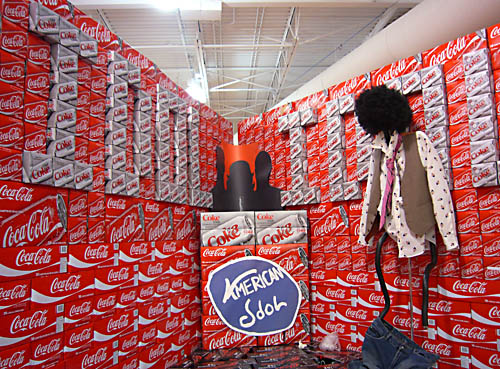
With the purchase of a large fountain Coca-Cola® at a Regal theatre, moviegoers can win a trip to Hollywood to attend the American Idol Finale this May!
Coca-Cola North America has been an official sponsor of the number one-rated television program, American Idol, for all of its nine seasons on Tuesdays and Wednesdays on FOX. Coca-Cola has joined forces with Regal Entertainment Group (NYSE: RGC), a leading motion picture exhibitor owning and operating the nation's largest theatre circuit, to launch the "Picture Your Family at the Idol Finale" Sweepstakes.
Coca-Cola is the official sponsor of the Sweepstakes, which runs through April 1. Regal Crown Club members 18 years or older can enter for their chance to win the grand prize of a trip for four to attend the two-part American Idol Finale at the NOKIA Theatre L.A. Live. To enter, moviegoers can sign up or use their existing Regal Crown Club card when purchasing any large Coca-Cola fountain product. Fans can also enter for free by mailing a 3x5 card printed with the information described in the Official Rules in a business size (#10) envelope to: Regal Crown Club/Coca-Cola/American Idol Entries, 7132 Regal Lane, Knoxville, TN 37918. Mailed entries must be received by 4/1/2010. For Official Rules and complete details, visit www.REGmovies.com.
"Regal theatres continue to be a great partner of Coca-Cola. We are excited to jointly launch this customized American Idol sweepstakes that will reward one of Regal's loyal consumers with a trip to the American Idol Finale. We look forward to continue working with Regal to develop unique, value-added promotions that enhance the moviegoing experience for Regal consumers," said Stefanie Miller, Coca-Cola North America Vice President of Strategic Partnership Marketing.
"Through our partnership with Coca-Cola, Regal Crown Club members have a chance to see the Finale of this very popular show in person. Regal Entertainment Group is thrilled to give our most loyal moviegoers the opportunity to take their family to see these rising stars and to experience the excitement and glamour that is L.A. LIVE," stated Dick Westerling, Regal Entertainment Group Senior Vice President of Marketing and Advertising. "Coca-Cola is a premiere partner for Regal and we are honored to once again collaborate through this tremendous promotion."
With more than six million active members, Regal Crown Club is the number one theatre loyalty program in the country. The Regal Crown Club allows moviegoers to accumulate credits at the box office and concession stand to earn free popcorn, soft drinks and movies. Regal Crown Club membership is free and open to everyone 13 years of age and older. Membership is obtainable at any Regal Entertainment Group theatre or online at www.REGmovies.com. Full contest rules are also available online.
About Coca-Cola North America
Coca-Cola North America is a unit of The Coca-Cola Company, the world's largest beverage company, refreshing consumers with more than 500 sparkling and still brands. Together with Coca-Cola®, recognized as the world's most valuable brand, the Company's portfolio includes 14 billion dollar brands, including Diet
Fanta®, Sprite®, Coca-Cola Zero®, vitaminwater, POWERADE®, Minute Maid®, Simply® and Georgia® Coffee. Globally, we are the No. 1 provider of sparkling beverages, juices and juice drinks and ready-to-drink teas and coffees. Through the world's largest beverage distribution system, consumers in more than 200 countries enjoy the Company's beverages at a rate of 1.6 billion servings a day. With an enduring commitment to building sustainable communities, our Company is focused on initiatives that protect the environment, conserve resources and enhance the economic development of the communities where we operate. For more information about our For more information about our Company, please visit our website at www.thecoca-colacompany.com.
About Regal Entertainment Group
Regal Entertainment Group (NYSE: RGC) is the largest motion picture exhibitor in the United States. The Company's theatre circuit, comprising Regal Cinemas, United Artists Theatres and Edwards Theatres, operates 6,768 screens in 548 locations in 39 states and the District of Columbia. Regal operates theatres in all of the top 32 and 44 of the top 50 U.S. designated market areas. We believe that the size, reach and quality of the Company's theatre circuit not only provide its patrons with a convenient and enjoyable movie-going experience, but is also an exceptional platform to realize economies of scale in theatre operations. Additional information is available on the Company's Web site at



 Much of the coverage of the Apple (AAPL) iPad has been on its lack of support for Adobe (ADBE) Flash. Steve Jobs thinks that Flash sucks. Adobe counters that many sites use Flash, particularly for video, and that Apple is giving their iPad customers an enfeebled web experience. Don’t get taken in by the technical chest-beating. This fight is about money and who will control delivery of video over the Internet — a business that’s likely to become a huge portion of the entertainment industry.